Why “Unbridling”?
Often, our true potential is challenged by the “CAN’Ts” prescribed for us by society, experts or even our own family’s definition of our possibilities. If you have a ‘disability’, the definitions seem to be so much more restrictive. Everyone else seems to know best what you cannot do. Of course, we don’t have to have a visible impairment to be disabled – fear, anxiety, prejudice, hatred, other people’s ideas of our possibilities – are all disabling. They bridle us.
Instead of going into a long philosophical discussion, I think the best way to give you an idea of what unbridling means to Sheryl and me, is to share an excerpt from a book we are busy writing. This was Sheryl’s take on a horse that no-one could ride:
A horse called Bismark had been dropped off on our farm.
“No-one wants him,” said the lady who brought him to us.
“Have you ridden him yourself?” Mom was fishing. If no-one else could ride Bismark, how could he be suitable for any of her children to ride? Especially Sheryl.
“Not really.” The woman banged the horse-box door closed before turning to face us. “But he’ll be a great endurance pony. I just don’t have the time. He’s a rebel without a cause. Nobody has managed to ride him into submission. I’m sure if you spend time with him …”
Bismark was difficult and he knew it. So, there he was on our farm, and I was determined not to get involved or to even begin to like him. That might sound a bit mean, but he came across as a mean horse. He was so aggressive that in one confrontation in the paddock he managed to turn my polocrosse horse upside down with his dominating behaviour. So, no – I did not – would not – like him.
I would go to the paddock and ride every other horse, talk to every other horse… just not him. I would go to the lands where the horses were grazing and brush every other horse but him. I ignored Bismark completely.
But – he was the only horse who would stop and look at me. This carried on for weeks. When I would fetch a horse from the lands to go for a ride, Bismark would glare at me as if to say, “You can’t ignore me anymore!” But I did – for a whole two weeks. And then one day I gave in. While the other horses ran away from work, he stood still that day. Gently putting the bridle over his head, I thought, “This is a bad idea”. I did not trust this horse at all. Very quickly I took the bridle off again. But of course, I went out the next day and the same thing happened. Day after day I would put the bridle over his head only to chicken out and remove it again.
Eventually I decided that I would go for a ride on Bismark as long as my dad joined me. My dad’s advice was “Just let him go – don’t try to stop him. Don’t pull on his mouth. The bridle mustn’t hold him back.” This was the best advice ever! I let him go in the biggest circle we could make and round and round we went. Fortunately, by the time my legs could no longer hold on, Bismark was also spent and all too happy to stop.
Bismark was one of the hardest-working horses I have ever ridden. I had the privilege to train him for endurance riding and to ride him on his first ever endurance ride. He did all the work – all I had to do was stay on. This misunderstood horse had only needed an opportunity to be himself – to do what he was designed to do – and that was to work.
Bismark taught me that often all we need is the opportunity to be what we were designed to be.
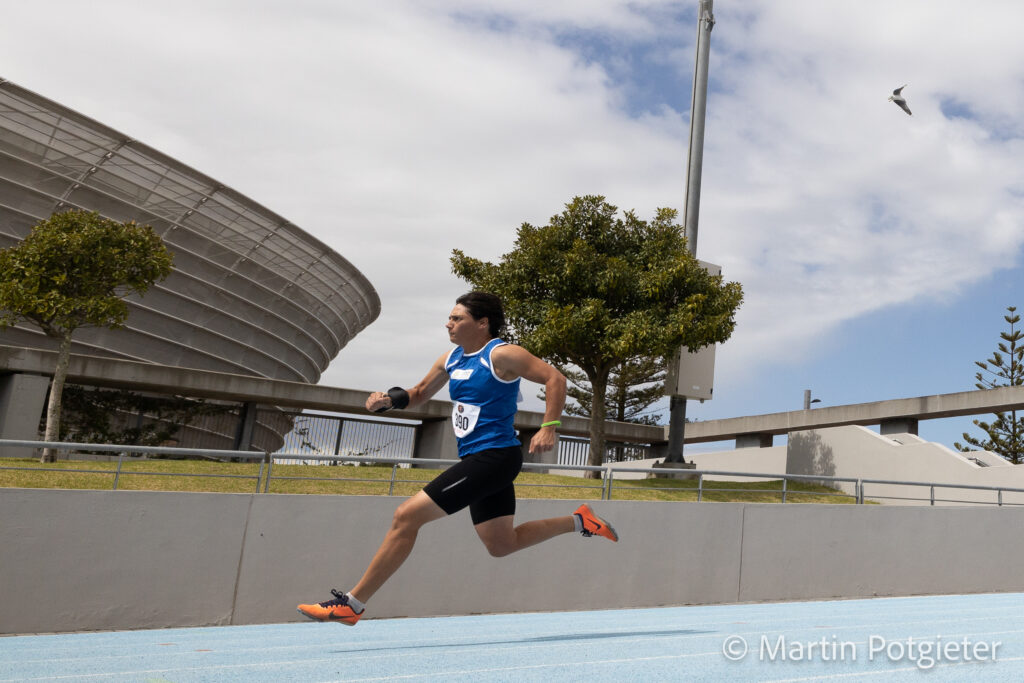
There ends the extract. The book is not about horses. It is about Sheryl’s quest to overcome society’s definitions of what she can or cannot do. Horses form an integral part of her adventure of self-discovery – an unplanned journey that progressed from frustration to horse riding to international athletics – the unbridling of her God-given abilities. The bridle, if used to dominate, tells a horse what it CAN’T do. Ideally, the bridle should be a source of communication between rider and horse, who form a team. It should communicate to the horse, what it CAN do. Using the bridle correctly unlocks the horse’s abilities and potential. Let’s call it unbridling?
Born cerebral palsied, Sheryl was bridled as a child – by medical opinion, expert advice, society’s general misunderstanding of ‘disability’ and even her own parents’ fears. Her father wouldn’t let her play polocrosse. She was told CP’s shouldn’t run ultra-marathons. A secret dream hung around the fringes of her consciousness. If she told anyone about it, she would sound crazy. Should she bury it in that dark place where abandoned dreams lie? Sheryl’s unbridling took years and is still in process. We invite you to join us as we share some of the journey and how it is impacting others who also need the opportunity to be what they were designed to be.
Sandy
About the bloggers:
Sometimes we travel for miles without having to speak. Then there are times when we need hours to talk about all the wild ideas that somehow surface when we are on the road together or on a flight to somewhere. Sometimes Sheryl and I complete each other’s sentences. On our “About us” page, you can learn more about who Sheryl is. I am her mom. Our blog will be like our road trips or flights travelled together – we might complete each other’s sentences. Sometimes I will blog and sometimes Sheryl will. Let’s see what happens … we hope you enjoy the journey with us.
Sheryl is a super wonderful and so humble. What exciting times to be part of her journey from the start. You can’t help but to love ❤ her.
Mandilene
I love this first blog entry and look forward to following your journey. Best, Liezel.