A few years ago we were all, in one way or another, affected by the covid-19 global pandemic. During lockdown we experienced various degrees of restrictions on movement. During the first phase of lockdown we were not even allowed to leave our homes except under exceptional circumstances. As the months dragged by in 2020, each government announcement was anticipated with a sense of apprehension. Speculation was rife about which restrictions would be lifted and which upheld or made more severe.
If covid-19 did nothing else, it perhaps gave us a greater understanding and appreciation of the term “mobility impaired”. How did we feel when we were confined to our own quarters for weeks on end with nowhere to go? For many of us, this was a temporary “impairment”. With the announcement of a move to a less severe level of lockdown, we celebrated a relative sense of freedom that we had only dreamed of under complete lockdown. We revelled in a mere trip to the supermarket. “Yay! I can get in my car and go and buy eggs!” Came a day when we were able to travel to another province without a wad of paperwork that legitimized the trip. It felt like I can only imagine it must feel when a prisoner is finally released from a morbid cell.
Have you ever imagined what it would have been like if that severe state of lockdown in 2020 was permanent. Imagine those who live with permanent mobility impairments? The loss of one or more limbs, those who are wheelchair bound, or those forced to be bed-ridden by one or other physical condition. Their freedom of movement is not dependent on an announcement that lockdown is being eased.
However, much can be done to enhance the quality of life and sense of well-being of those with mobility impairments. Have you ever watched an eagle mounting up from its perch? It first flaps its wings energetically. Eventually it trusts in a thermal updraft and launches. It is able to keep its wings outstretched and completely still while it soars effortlessly through the air. Have you ever wished you could fly? That longing is not reserved for ‘able-bodied’ people.
While humans cannot fly, the feeling of satisfaction when we achieve something we have never done before, or when we overcome our own “gravity” issues in situations, could possibly be likened to the sensation of flying. IsAbility Sports Club Limpopo was brought into being to inspire differently abled, as well as able-bodied citizens to become involved in activities that enhance a general sense of well-being. They also try to network and open up educational, skills development and employment opportunities for people with disabilities. In September 2020, while covid-19 was still playing havoc with the world, Isability launched a project called: “Fit-to-fly”.
This project provides access to assistive devices such as standing and sitting frames for cerebral palsied children (and adults) as well as other patients with spasticity and physical impairments that affect posture and mobility. Although frames can be manufactured using a generic pattern, each frame is individually adjusted to be made comfortable for the unique patient’s need. The name “Fit-to-fly” is associated with the notion of the frame or apparatus being made to FIT the unique patient, and subsequently the frame being able to enhance the patient’s sense of achievement and physical and emotional well-being so that he or she can believe that “FLYING” is possible (of course in the figurative sense.) In another sense, we can all be made “fit” to achieve more than we thought possible. This is both physical and a mindset.
Successful collaboration between the Physiotheraphy clinic at a Limpopo Public health facility and local Non-profit Organisation, ‘IsAbility’, is quickly proving that Public health services need not be discouraged or feel limited by a lack of government resources in terms of assistive devices for rural patients. Nestled at the foot of the Soutpansberg in the Limpopo Province, is the quiet town of Louis Trichardt. Here meaningful collaboration between the physiotherapy programme at the local Government hospital and a non-profit association called “IsAbility Sports Club Limpopo”, is having an increasingly significant impact on the largely rural community of people with disabilities in one of the poorest provinces in South Africa.
Outpatients at public hospitals in South Africa have access to Physiotherapists and Occupational therapists, who are able to visit the patients at home or see them at the hospital from time to time. These therapists cannot be at a patient’s home 24/7, BUT with the aid of a standing or sitting frame, the patient is able to sustain advisable and healthy posture for extended periods of time during the day or night. Some of these patients are unable to stand on their own at all, or unable to sit upright without assistance. However they are often intellectually alert and are able to perform academic and fun activities such as playing with clay and colouring in, if they can be supported in a suitable body position.
Being supported in the correct standing position is vital for children with problems related to posture and movement. They are able to bear weight which would ordinarily not be possible due to their inability to stand on their own. This weight bearing assists the development and strengthening of the hip joint, as well as benefitting bone growth and bone density. Muscles are strengthened and lung function and bowel function improved. Since the child is able to “stand”, eye contact can be made and this appears to improve visual alertness and enables the child to feel more at ease communicating with others.
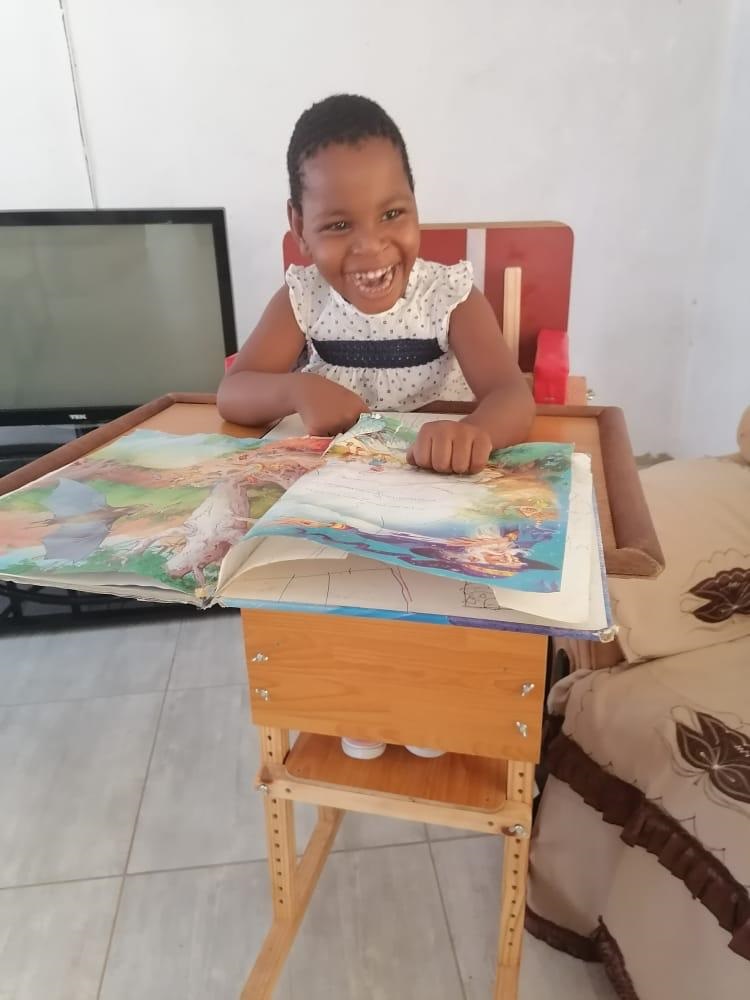
Since the first Fit-To-Fly standing frame was issued on 28 September 2020, 18 more frames have been purchased and issued to needy clients. (Pictured is the first recipient of a standing frame on the “Fit-to-fly” initiative: a happy Dzitengo Mango). Each client is monitored and followed up by the rehabilitation team every six to twelve weeks depending on their needs and progress. Once the patient outgrows or does not need the device anymore, it is returned and re-distributed.
As the programme has progressed, to date 3 children started to walk and do not need the frames anymore. Upper limb function and skill, eye contact, speech and self-feeding are amongst the developmental milestones that improved with the use of the standing frames. One child has outgrown his frame and received a bigger one.
Bringing other sectors of the community into play, IsAbility has a drive at some local schools to encourage outreach groups to contribute or donate educational materials to the Fit-to-fly programme. These educational materials can be used by the children who are using assistive devices. Such materials include clay, foam, building blocks, crayons, colouring books etc. While a child might ordinarily not be able to maintain a body position that would enable such an activity, the assistive device enables the child to be pro-actively involved in educational activities while using the device, and frees up parents and family members who would otherwise have had to support the child in an upright position for the activity.
The energy and united sense of purpose that such collaboration can create between the public health service and a willing local NPO or NGO, together with possible input from other stakeholders, makes this a feasible and affordable alternative to waiting for years before public funding provides assistive devices to children.
After all, we can all be fit to fly!