What is inclusive education?
Inclusive education gives learners with physical disabilities access to mainstream schooling. Is it an impossibly difficult task? No. It starts with the will to make it happen.
Jumping Kids drives inclusive education
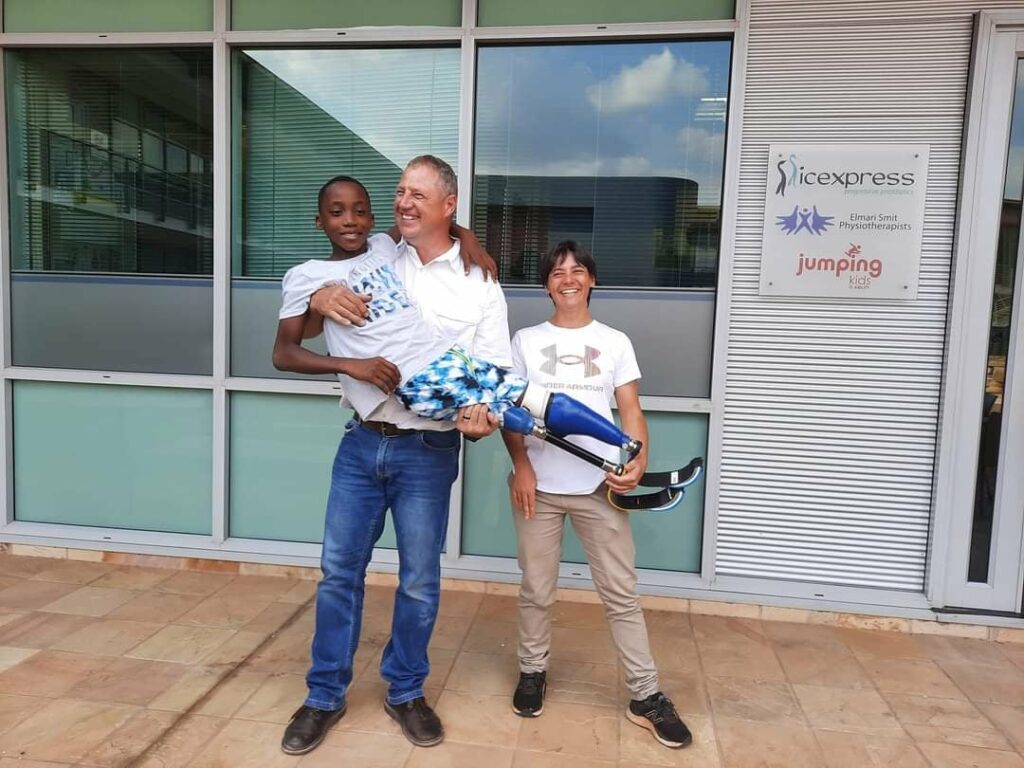
Jumping Kids is a Non-profit and a Public Benefit Organisation that provides prosthetic limbs to children with limb amputations. This improves their mobility and facilitates access to school and other activities that most able-bodied children take for granted. Although the JK programme has advanced inclusive education in Gauteng for more than a decade, it was only a few years back that Vhutuhawe Nemutandani (pictured) became the first learner on the Jumping Kids programme in Limpopo.
Vhutu’s inclusive education journey
Vhutu was born with a condition called ‘tibial hemimelia’, resulting in his double amputation at a young age. His mother passed away early in his life, leaving him in the care of his guardian. He attended a Special School for a number of years. This all changed in 2018 when Vhutu became the recipient of prosthetic limbs courtesy of Jumping Kids. Suddenly he was mobile. He tasted a new sense of freedom and was ready to shift his boundaries. Vhutu was stagnating academically, although he was thankful for the specialised attention he received at his Special school. In 2021 he was enrolled in grade 5 in a mainstream independent school in Louis Trichardt, (Emmanuel Christian School/ECS). He is now in grade 8. He takes his role as the Limpopo Junior JK ambassador seriously and assists with awareness activities at both Special and Mainstream Schools.
Inclusive education project grows
In January 2024, two more boys joined Vhutu at ECS. Ndieni Netshavhambe has a condition called ectrodactyly, while Wamanda Mathisa is a single leg amputee. Vhutu and Ndieni are currently in grade 8 and Wamanda in grade 3. Jumping Kids and Isability have set up a 3-bedroomed flat in Louis Trichardt to accommodate the JK children who now attend mainstream school together. This was made possible by funding from De Beers, Komatsu and The Summit Africa Foundation. The boys are cared for by a resident house mother.
Vhutu consistently performs in the top 10 in his class of 50 learners. As the programme unfolds, many are becoming aware of the ease with which inclusive education can be accomplished. Ongoing attention to greater levels of inclusivity will have a positive impact on communities where children and people with ‘disabilities’ are often ‘hidden away’. These children traditionally face serious accessibility challenges and limited opportunities. Skills development, tertiary education and employment are rare commodities for a ‘disabled’ person. Remember, once you know it, grow it! If you are aware of the need for INCLUSIVE EDUCATION, spread the word!