Africa: 05h30
05h30. Sheryl arrives outside the farmhouse in her Suzuki Jimny. She always seems to bring some wind with her when she pulls in – full speed and then full stop. The view is vaporous as I peer out of the kitchen window to check if she has her training kit on. I can barely make out the weeds in the vegie garden on the upper terrace. The mountain is vaguely silhouetted against a soggy sky. A lone bird whistles across the valley in the mist and rain. We have to decide … are we doing this?
It’s probably raining in Thohoyandou as well. Probably raining harder there.
“Don’t wash your windscreen with a pressure hose for at least three days”, was the instruction from the gentleman who installed my new windscreen yesterday. “A bit of rain should be okay on the screen, but don’t overdo it.” He shouldn’t have said that to someone who tends to overthink things.
“Are you ready?” Sheryl breezes in through the kitchen door. We had planned to take the “back” road to Thohoyandou. It’s about 70 kilometres but it takes over an hour because the speed limit is mostly 60 km per hour through the rural residential areas. And the speed bumps! The traffic? The road? The rain? The windscreen? So many “ifs”.
We pile Sheryl’s gear into my car and leave in the rain. The coffee in the travel mugs is steaming hot.
A slow, careful drive through Africa
It’s a slow, careful drive through the Soutpansberg Mountains and beyond. Hundreds of school children are walking in the rain on the side of the road – either to school or a bus stop or taxi rank. Some of them have umbrellas. Most don’t. Nevertheless, they are on their way to school. Life goes on in Africa.
For some good reason that a woman would not understand, the windscreen guy also told me, “Don’t remove the piece of duck-tape. Under no circumstances should you remove it tonight. Let it come off of its own accord tomorrow.” (It was pasted from the upper part of the windscreen up and over onto the roof of the Fortuner). As we drive, I am aware of the duck-tape flapping in the wind and the rain. Houses of all shapes, sizes and status are spread across the slopes and in the valleys, the closest ones nestling right next to the winding road alongside the odd Spaza shops, Car-wash stations, open-air Hair salons, church buildings and schools. Smoke rises against the rain where some vendors have their fires going and will shortly have piles of hot, charred mealies ready to tempt passers-by. The smell of burning wood and African bush drifts through the window we have opened slightly to stop the inside of the windscreen from misting over.
Of mist and mountains and wild Africa
The turn onto the Sibasa road marks the lowest altitude of our journey. We have left most of the awful speed bumps behind and now only have mist and trucks to contend with as we being to climb again. This road winds up through lush indigenous forest and plantations of pine trees. You have to drive as if someone is going to drive at you head-on around the next curve or blind rise – because that is exactly what might happen in the Limpopo traffic. (Maybe that is a generalisation – let’s keep it general). The mist makes matters worse. I am actually not thinking about the traffic at the moment though. My gaze is on the road but my mind is in the forests alongside. I think of Samango monkeys and red duiker… of bushbuck and bush-pigs and leopard… of the privilege of living in a place like this. Glad we chose this route today and not the one south of the mountain where you drive through built up areas most of the way.
When we reach Thohoyandou, we are greeted by a friendly security guard at the entrance to the Makwarela track and after a quick exchange in Tshivenda, we are through the gates. I realise that, somewhere along the way, the duck-tape must have detached itself from my windscreen. My windscreen is still intact. The soccer field has weeds and long grass in patches. Perhaps they haven’t been able to neaten it up due to the constant rain. But the tartan track is still okay for a good session. And it is dry. There are a few older people diligently doing a slow shuffle around the track as part of their daily routine. They are fondly called the “Golden oldies” in Thulamela.
African skies
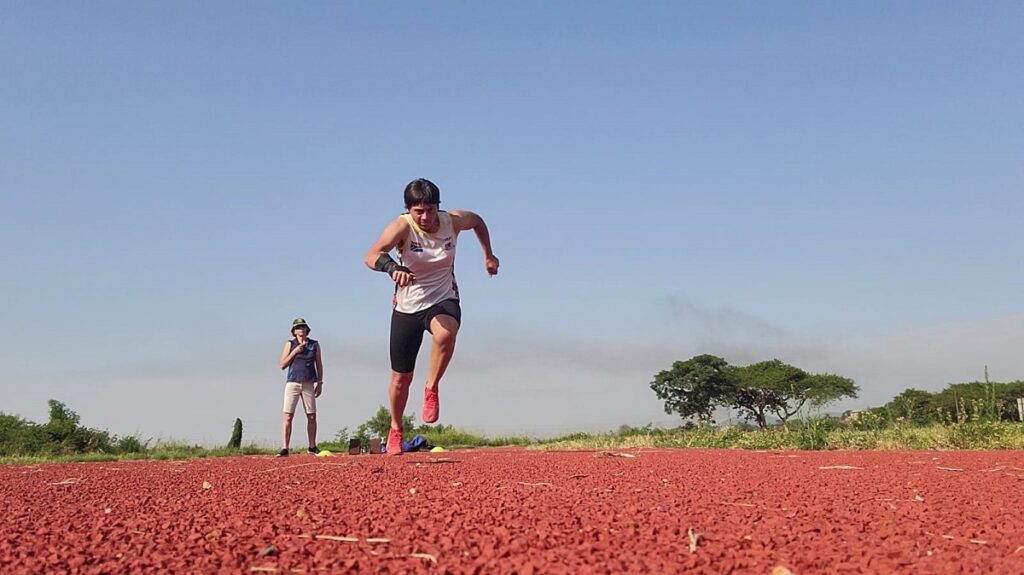
Sheryl places her cones at strategic points and settles in for a routine training spell. The skies have cleared and the African sun has begun to do what it does best. The job must go on. Another lovely day in Africa.
Sandy
(Written after a morning’s training jaunt to Thohoyandou; January 2024)
I am out of breath just trying to keep up!!